Digital programme
Individual assessments and five personal documents per participant, plus an aggregated company report where privacy conditions allow.
Self-guided delivery. No scheduled personal consultation.
Digital wellbeing programme for workplaces
Messages in meetings. Work chats after hours. Your people bring their whole lives to work, and their screen habits travel with them.
Give your company a group overview and your people personal reports and six weeks of practices, built around their answers.
A free first conversation. We write back within two working days.For your company.
For your people.
Personal support for your employees. A clearer basis for your next decision.
Group reporting depends on the group-size and individual-protection requirements being met.
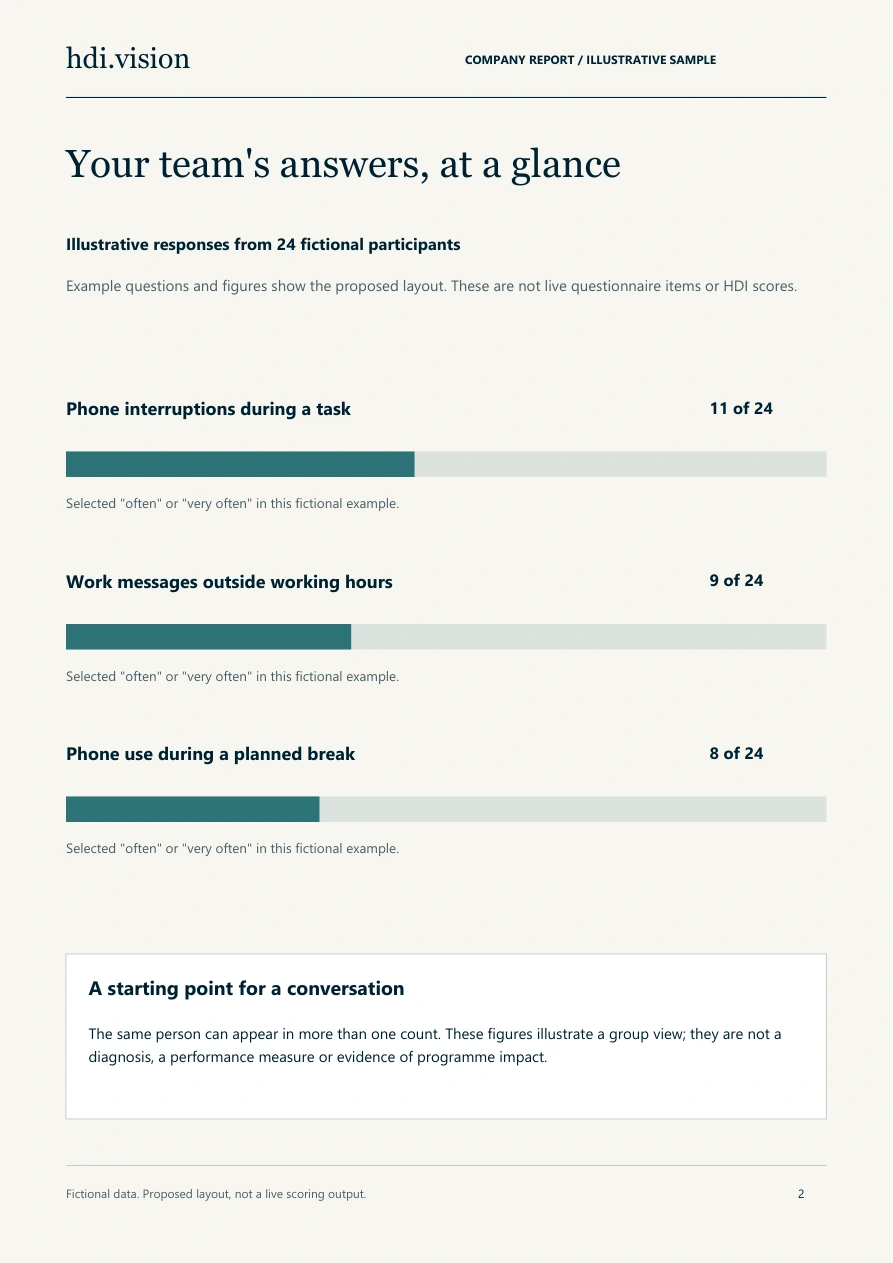
FOR YOUR COMPANY
A shared picture. A clearer next step.
Explore how a group overview can support a conversation about your workplace.
Illustrative sample with fictional data. Proposed report layout. PDF opens in a new tab.
Different people, different solutions.
Your people bring different habits, pressures and sources of fulfilment. Each participant's answers shape their personal analysis and six-week plan.
The report helps them understand their own patterns. The plan gives them relevant practices to choose from, with room to adapt them to their life - at work and at home.
A creative side, chosen for each person. Their programme also includes 36 stories selected from our library, films to watch and books to read. Chosen to complement their personal programme, these offer different ways to explore an idea, recognise themselves in a story and find inspiration for everyday life.
These samples use Lucija's fictional demonstration answers.
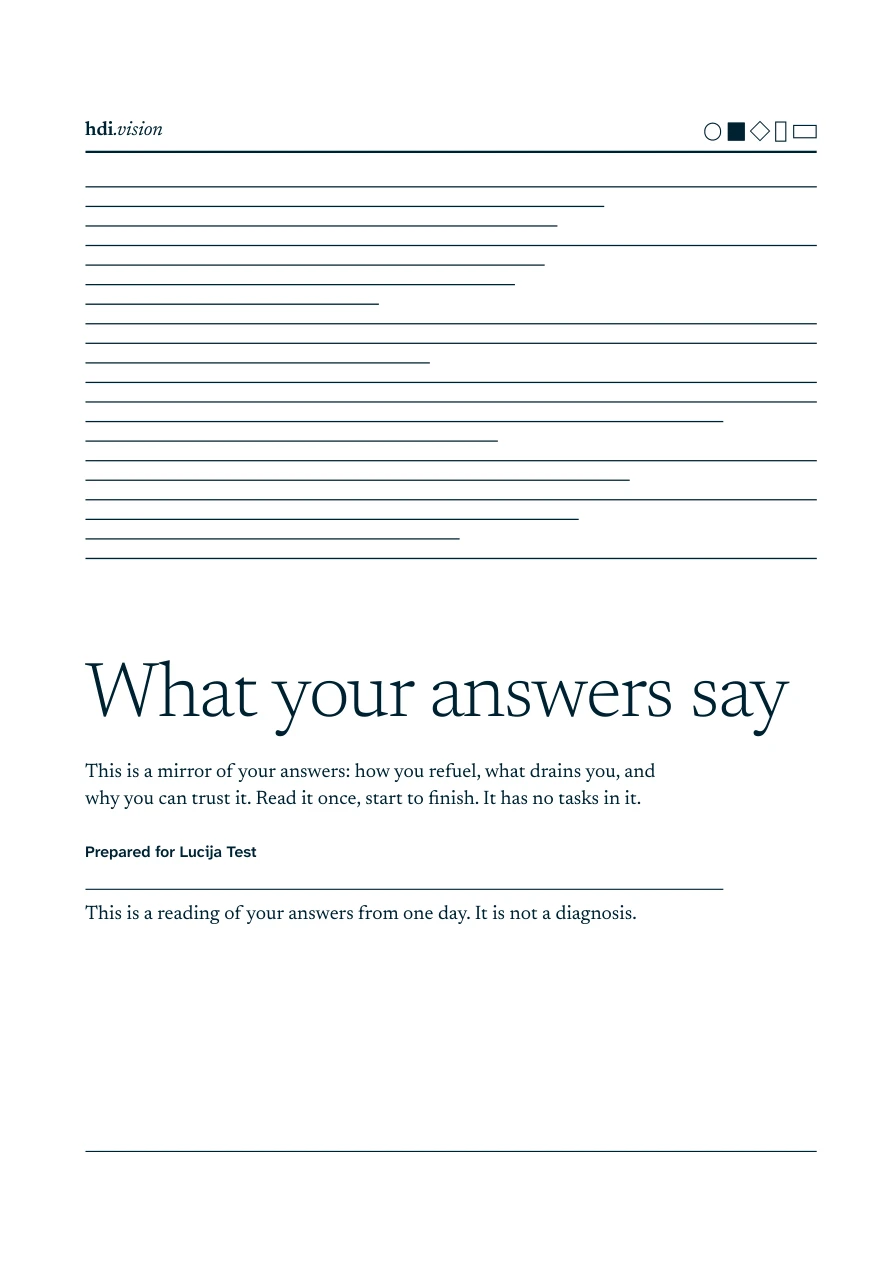
A personal reading of their digital habits, pressures and sources of energy.
Open PDF (new tab)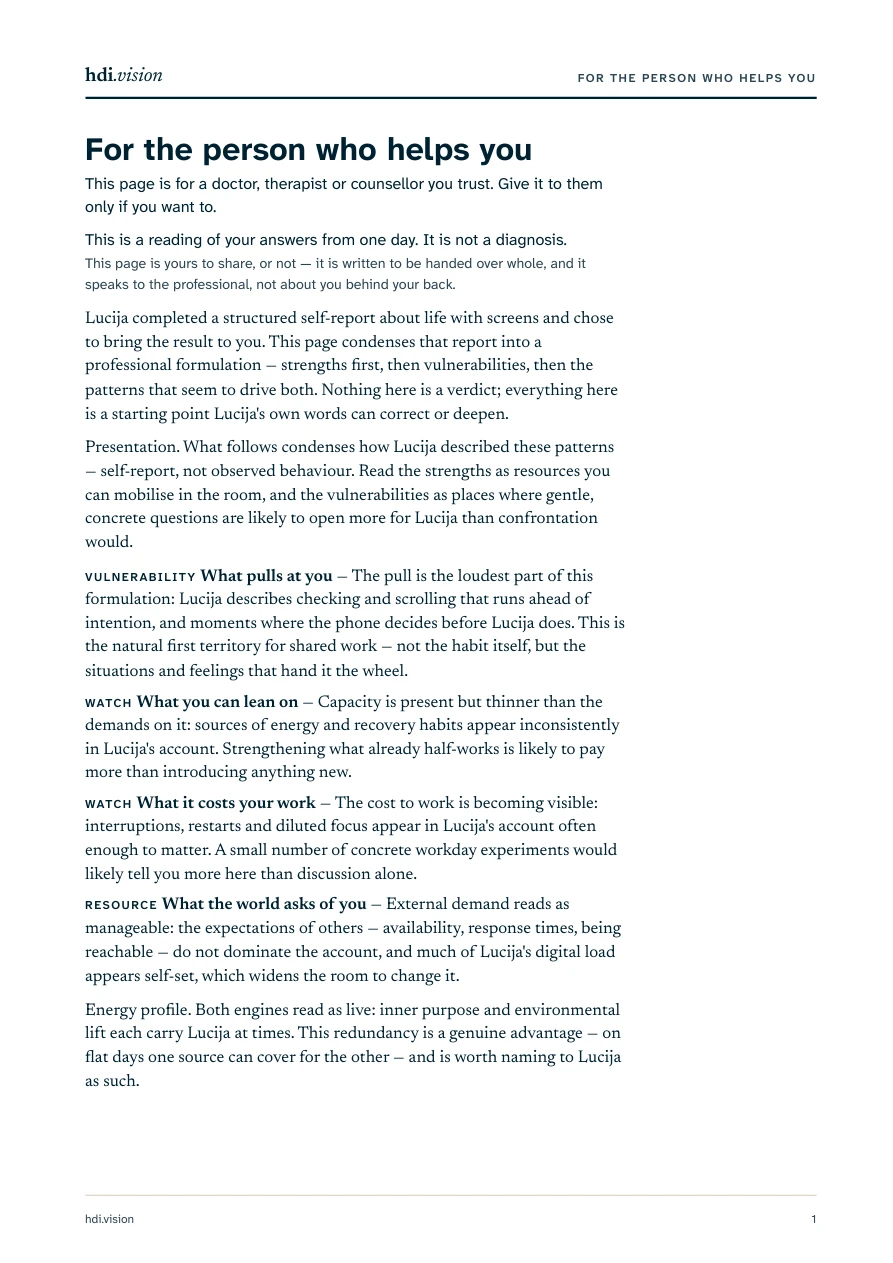
A short letter they can choose to share with a doctor, therapist or counsellor.
Open PDF (new tab)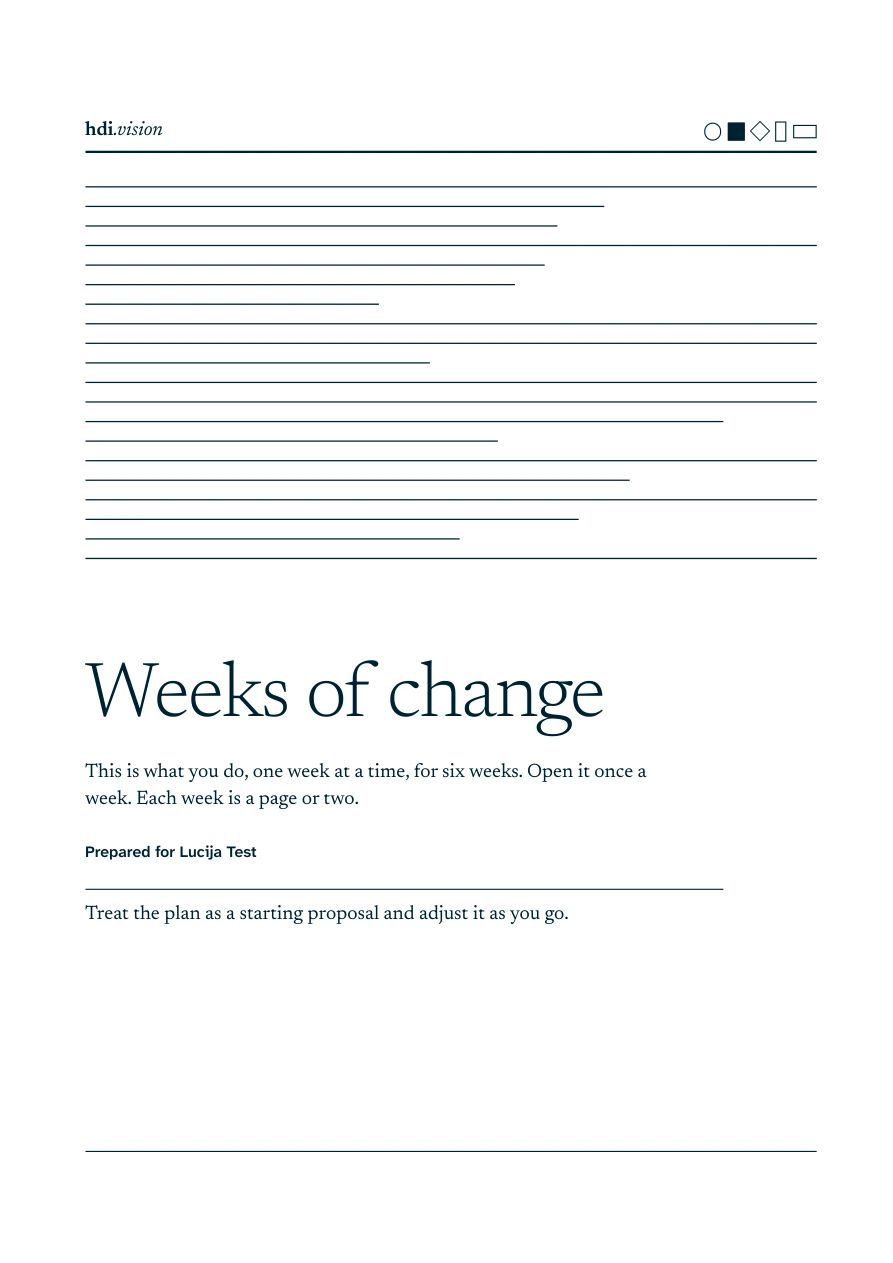
Six weeks of selected practices to explore and adapt at their own pace.
Open PDF (new tab)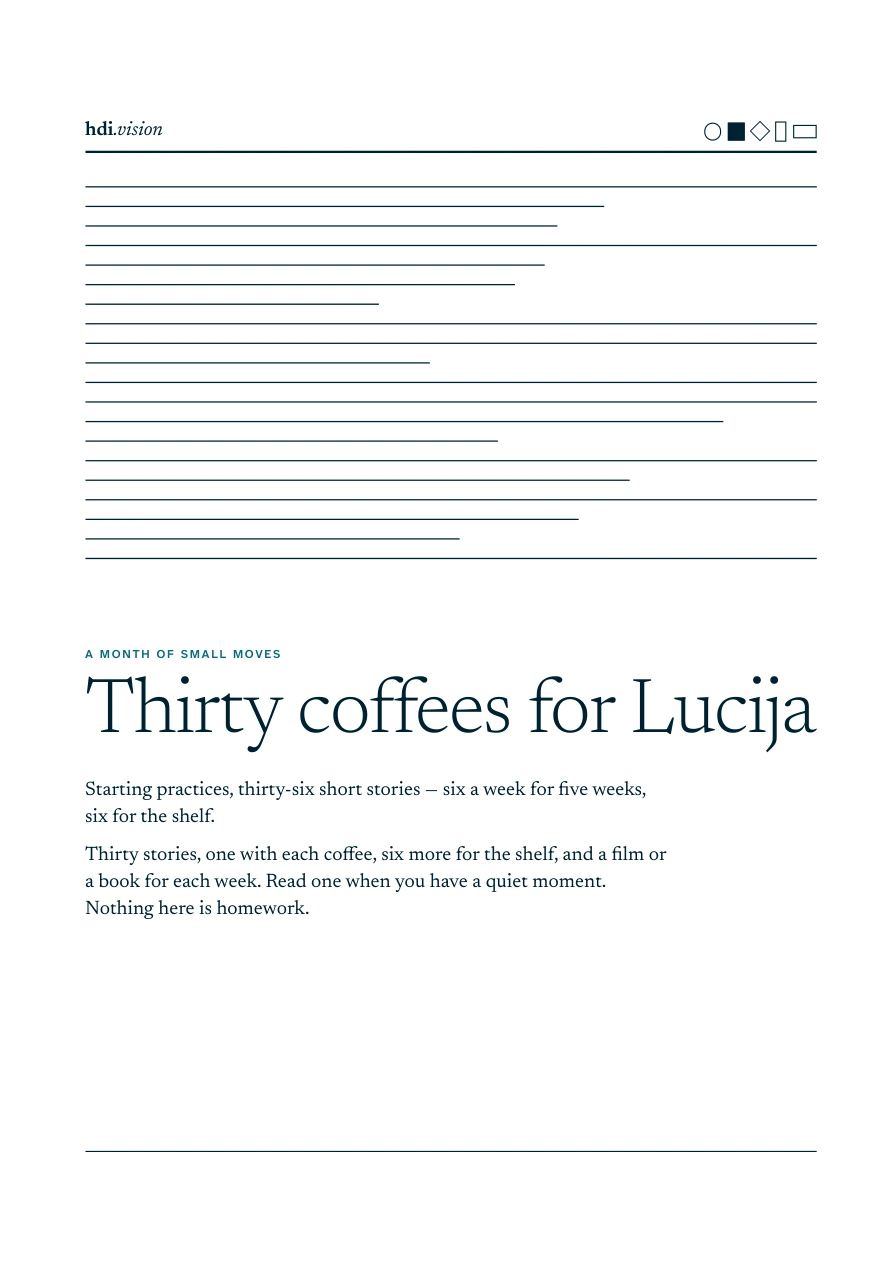
36 selected stories, with film and book suggestions to inspire reflection beyond the screen.
Open PDF (new tab)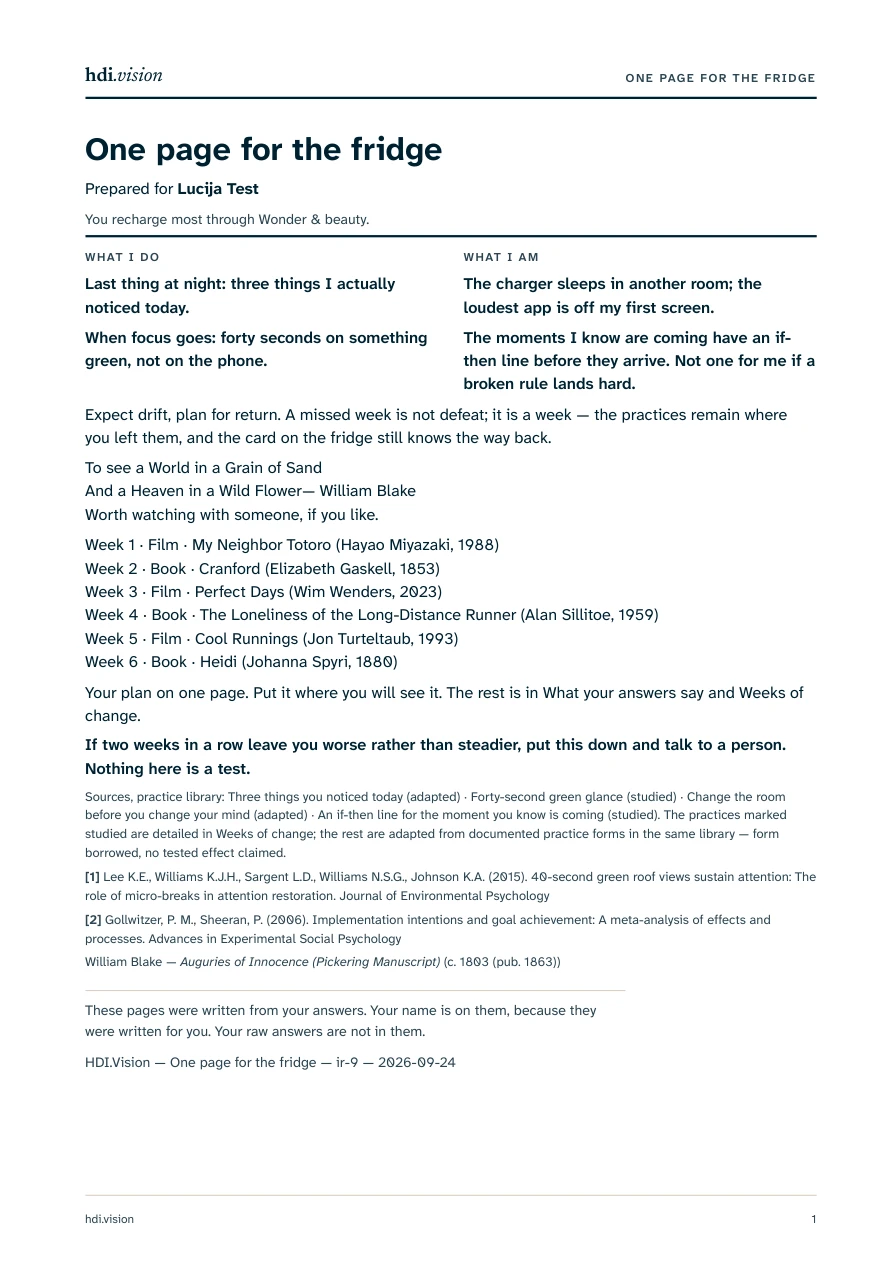
A one-page reminder that keeps their chosen practices within reach in everyday life.
Open PDF (new tab)YOUR PROGRAMME
Preview: payment is not enabled. You can review a package now. No order is placed.
Indicative proposal only. Workplace prices are being reviewed and are not available to purchase. Amounts exclude VAT; on-site travel is additional.
Individual assessments and five personal documents per participant, plus an aggregated company report where privacy conditions allow.
Self-guided delivery. No scheduled personal consultation.
The digital programme plus a proposed 60-minute session and 30 minutes for questions.
+ €900
Indicative supplement, excluding VAT
The digital programme plus a proposed workshop of up to three hours for one group, up to 25 people.
+ €1800
Indicative supplement, excluding VAT and travel
Travel and additional groups quoted separately.
| Capacity | Indicative price |
|---|---|
| Up to 20 people | €790 |
| Up to 50 people | €1490 |
| Up to 100 people | €2490 |
| Up to 250 people | €4990 |
Prices are shown so you can plan. Ordering opens when the test opens.
Employers receive permitted aggregated findings, not employees’ personal reports. Live-session availability, group arrangements and final commercial terms require confirmation.
Not yet. This is a package and order preview. Card payment will be connected after testing; no payment or order is created here.
Download rights, online access duration, repeat assessments, age transitions and support are still being finalised. The final terms will be shown before payment becomes available.
No. The programme provides educational guidance and practical reflection. It does not replace professional care.
A clear start.
Six weeks of practices.
A next step together.
Start with one team. Agree the scope before the first invitation.
We discuss your people, priorities and timing, then set out seats, services and price in a written offer.
HDI prepares the offer. Your company agrees the scope and dates.
Participants join with your workplace's code and their own account. Each person answers on their own phone or computer.
Your company invites the team. Each participant completes their own test.
Each person receives their documents, reads, chooses practices and works at their own pace.
HDI provides the personal programme. Your people choose what to try.
Participants are invited to answer again. We discuss the available group results with you and consider how to continue.
HDI guides the conversation. Your company decides the next step.
Personal answers.
Clear boundaries.
Make the boundaries clear from the start.

Work is one part of their day. Relationships, rest, responsibilities and the things that make life meaningful travel with them.
Screen habits run through all of it: what draws their attention, how they spend a break, how they unwind and how present they feel with other people.
Our reports look beyond interruptions and efficiency. They help each person reflect on how digital habits fit into their wider life - what supports them, what drains them and what they would like to change.
We believe that helping people build a more fulfilling life is a worthwhile investment in the people your company depends on.


Human Digital Intelligence was developed with students and employees of Algebra Bernays University in Zagreb. Our founder teaches there as a senior lecturer. The programme was first used with the people he sees every week.
In his doctoral work, our founder studied 227 employed adults, asking about the pull of social media and attention at work. That connection to HDI is a conflict of interest, stated alongside the research.
The study helps frame the questions we explore. Its methods, findings, limitations and publication status are available on our research page.
Tell us about your workplace, the people you have in mind and what prompted you to explore this.
We'll discuss how the programme could fit your organisation and set out the scope, timing and price in a written offer.
Yes. We agree the group and scope with you. The available group reporting depends on participation and privacy requirements.
Seats, included services, dates and price. An education session can be included by agreement. Public institutions receive an offer in the form their procurement needs.
We reply by e-mail. The first conversation is free and helps us understand your needs before preparing an offer.
THE DARK SIDE OF DIGITAL LIFE
What happens on a screen can follow your people into their sleep, relationships and working day.
The same people. The other side of their day.
A person can arrive at work carrying a night that never quite ended.
A late feed. An early alarm. Less room to recover.
A message, a score, a worry that keeps coming back.
Money worries or a conversation at home left unfinished.
The feeling that being available is part of being reliable.
Illustrative situations to recognise and discuss, not a diagnosis of your team.
02 / FOUR EVERYDAY PATTERNS
Four ways screen habits can take more than your time.
Fictional screens with AI-generated photographs. Select a horseman to explore the pattern and the questions behind it.
You open a screen to finish one thing. Messages, updates and quick checks keep pulling you into something else.
What keeps taking you away from what you meant to do?
Other people’s lives become a measuring stick for your own. Alarming headlines and unpleasant exchanges stay with you after you leave the screen.
How do you feel about your own life after you put the phone down?
Bedtime passes while the feed continues. A break becomes more screen time, and tiredness is something you notice only when it is hard to ignore.
Does your way of switching off leave you feeling restored?
You are with someone, but part of your attention is elsewhere. An enjoyable moment is interrupted to check what is happening online.
Who or what is waiting for your full attention?
Your answers help you recognise which of these patterns show up in your everyday life.
Four themes for reflection, not four diagnoses or separate test scores. Personal answers remain subject to the sharing and privacy boundaries described in the programme.
An imagined day. Small moments that leave less room for everything else.
The feed is already setting the mood.
Lunch comes with headlines, scores and notifications.
A quick question opens the laptop again.
One more scroll. One more round. The alarm gets closer.
Start with a conversation people can choose to join.
Ask about pressures, expectations and the room people have to disconnect. Make participation and access to personal results clear from the start.
HDI works from participants’ answers. Their messages and browsing history stay theirs.
The colleague. The partner. The parent. The person awake when the rest of the house is asleep.
Digital wellbeing reaches beyond productivity. It includes how people rest, connect, spend their time and feel about their everyday lives.
Recognising a difficult pattern should open a supportive conversation. It should never become a label attached to an employee.
A wellbeing programme is not treatment for gambling or gaming disorders. Serious concerns deserve qualified professional support.
PROBLEMATIC SMARTPHONE USE / SOHN ET AL., 2019
In a review of 41 studies of children and young people, problematic smartphone use was associated with about three times the odds of depression and anxiety; almost all studies captured one moment in time, so this does not establish causation.
Large studies of hundreds of thousands of young people find only small links between everyday screen use and how they feel, and they leave open which comes first.
OUR FOUNDER'S DOCTORAL RESEARCH
At risk of social media addiction
according to the study's chosen scale threshold
About one in three respondents scored in the range the scale's authors describe as at risk of social media addiction; this is a screening result, not a diagnosis.
The study also found that the stronger the pull of social media, the harder people found it to hold their attention against interruptions at work; the self-reported, one-time survey does not establish causation.
WHO notes limitations in global estimates. This includes gambling beyond screens.
WHO · 2024 (new tab)Workers surveyed in selected sectors across four European countries, not all workers.
Eurofound · 2023 (new tab)These findings describe different populations and methods. They do not estimate risk in your company or demonstrate the effectiveness of HDI.
The four patterns above connect everyday experiences with topics explored in our questionnaire; they are not a new set of validated scales.
Help your people make more room for the lives they want to lead.
Explore personal reports, six weeks of practices and a group perspective for your organisation.