Adults exploring HDI educational practices · 4 min read
3A: making room for Alertness, Awe and Achievement
Understand the fifth HDI coper without mistaking research on awe for proof of the whole framework.
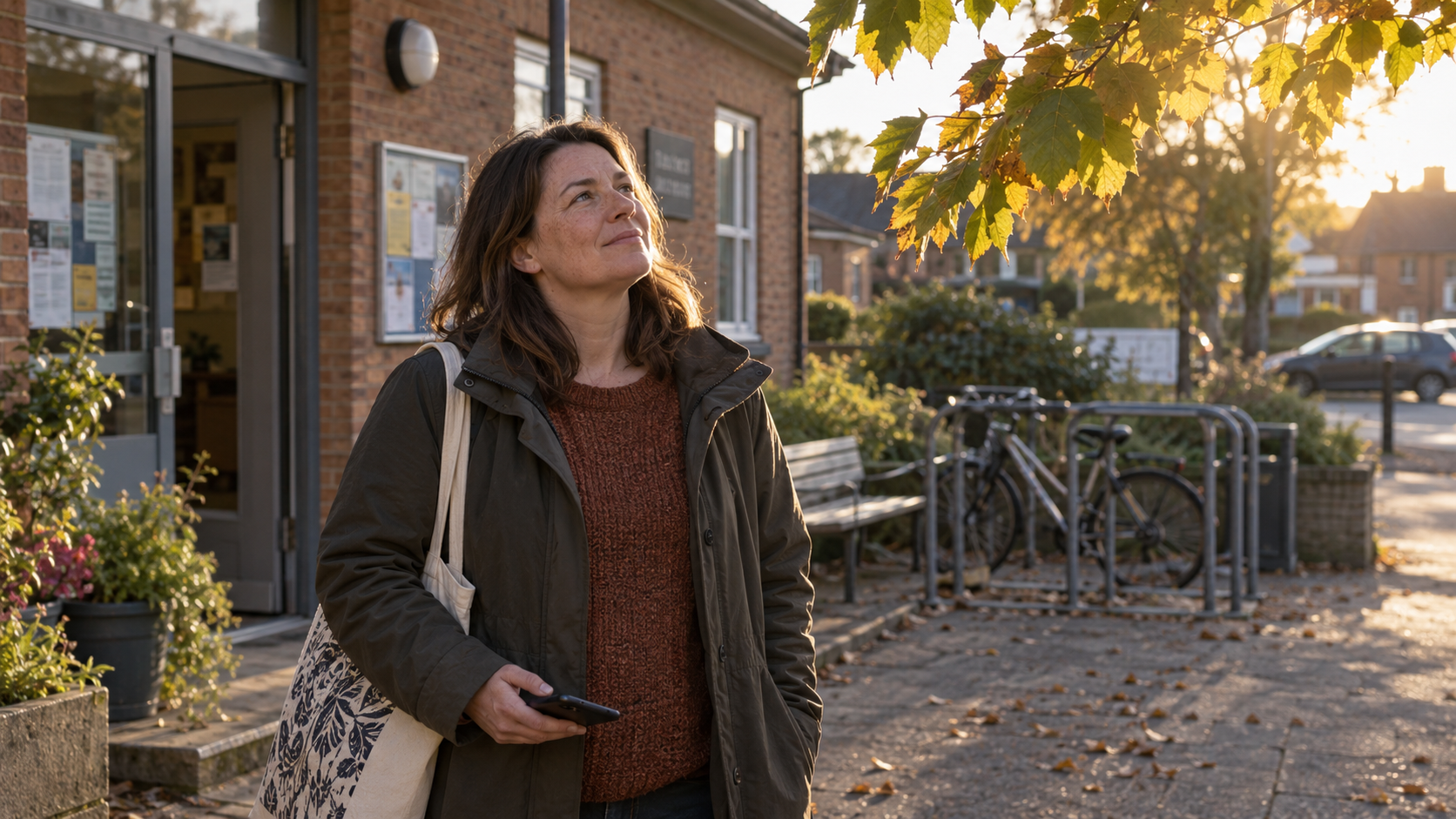
3A is HDI's name for an educational framework built around Alertness, Awe and Achievement. It invites you to pay attention to the world around you and make room for experiences that feel larger than your immediate concerns. Meaningful achievement is its proposed outcome, not something you must produce every time you pause.
The name belongs to HDI's proprietary model. Research on attention and awe can inform parts of it, but does not validate the complete sequence or establish a clinical scale. You can explore the ideas without treating a quiet moment as a test of digital resilience.
Alertness means noticing, not monitoring everything
In this framework, Alertness means outward, present awareness: noticing your surroundings and recognizing where your attention has gone. It does not mean remaining vigilant for every message, policing your thoughts or staying constantly productive.
Imagine a fictional example. Rosa waits outside a community hall after a class. She starts opening her usual feed, then notices the changing evening light across the building and the sound of the choir practising inside. Nothing extraordinary has to follow. She has simply chosen to attend to a moment she would otherwise have passed through.
You might try noticing one detail during an ordinary pause: a sound, a shape, the movement of a cloud, or how someone has made an object. Use an accessible setting and the senses available to you. This is an editorial practice suggestion, not a tested dose or an instruction to force a particular feeling.
Awe is more specific than “feeling good”
Piff and colleagues studied awe across five studies, including experiments, and found effects on some forms of prosocial responding. These findings concern specific experiences and measured responses; they do not show that looking at something impressive reliably improves every part of life. Piff et al.
In practical terms, awe might involve encountering something whose scale, complexity or beauty makes your usual perspective feel incomplete. There is no requirement for an expensive trip, a dramatic landscape or a photograph worth posting. You can remain open to the experience without having to manufacture it.
Awe also is not always comfortable. Gordon and colleagues distinguished a threat-related form from more positive experiences of awe. That is a reason to avoid presenting intensity or fear as inherently beneficial. Gordon et al.
What an awe-walk study actually found
Sturm and colleagues tested awe-oriented walks with healthy older adults. They found changes in some positive emotional experiences, while anxiety, depression and life satisfaction did not show the same improvement. The result is narrower than “awe treats distress”. Sturm et al.
An accessible walk or time observing from a comfortable place could be an option if it suits you. Adaptations for mobility, sensory access and personal safety matter. The seated version is a practical adaptation, not an intervention shown equivalent by that study.
Notice what the experience was like rather than searching for evidence that it worked. You might feel interested, moved, neutral or distracted. None requires you to invent a positive result. If something feels threatening or overwhelming, choose another activity or setting.
Achievement is a separate question
HDI uses Achievement to mean accomplishment that matters to you, rather than applause or a high output count. The proposed relationship between Alertness, Awe and that outcome remains a model question. The studies cited here do not demonstrate that this exact pair of ingredients produces achievement.
You can therefore keep two observations separate. First, did you choose to notice the world or encounter something that moved you? Second, did you make progress on something meaningful? An answer to one does not supply the answer to the other.
For Rosa, that might mean enjoying the evening sound and later deciding to practise a song at home. It could also mean simply going home. The moment does not become a failure because it yields no measurable accomplishment.
Try one modest opportunity that fits your day, then describe it in ordinary language. You do not need a streak, a score or a claim about repairing your brain. The framework is most useful when it helps you ask a clear question without pretending that the answer has already been scientifically settled.
Sources and scope
- Piff, P. K., et al. (2015). Awe, the small self, and prosocial behavior. PubMed; DOI 10.1037/pspi0000018.
- Gordon, A. M., et al. (2017). The dark side of the sublime: Distinguishing a threat-based variant of awe. University-hosted paper; DOI 10.1037/pspp0000120.
- Sturm, V. E., et al. (2022; online 2020). Big smile, small self: Awe walks promote prosocial positive emotions in older adults. PubMed; DOI 10.1037/emo0000876.
Sources supplied with this local draft; article claims and source admission remain subject to scientific review. These external works do not validate HDI’s questionnaire or establish the effectiveness of its programme. No external organisation’s endorsement is implied.