Parents · Understanding assessment · 4 min read
Your observations are a starting point. Your child is a person.
How to describe a difficult screen routine without turning an answer into a label for your child.
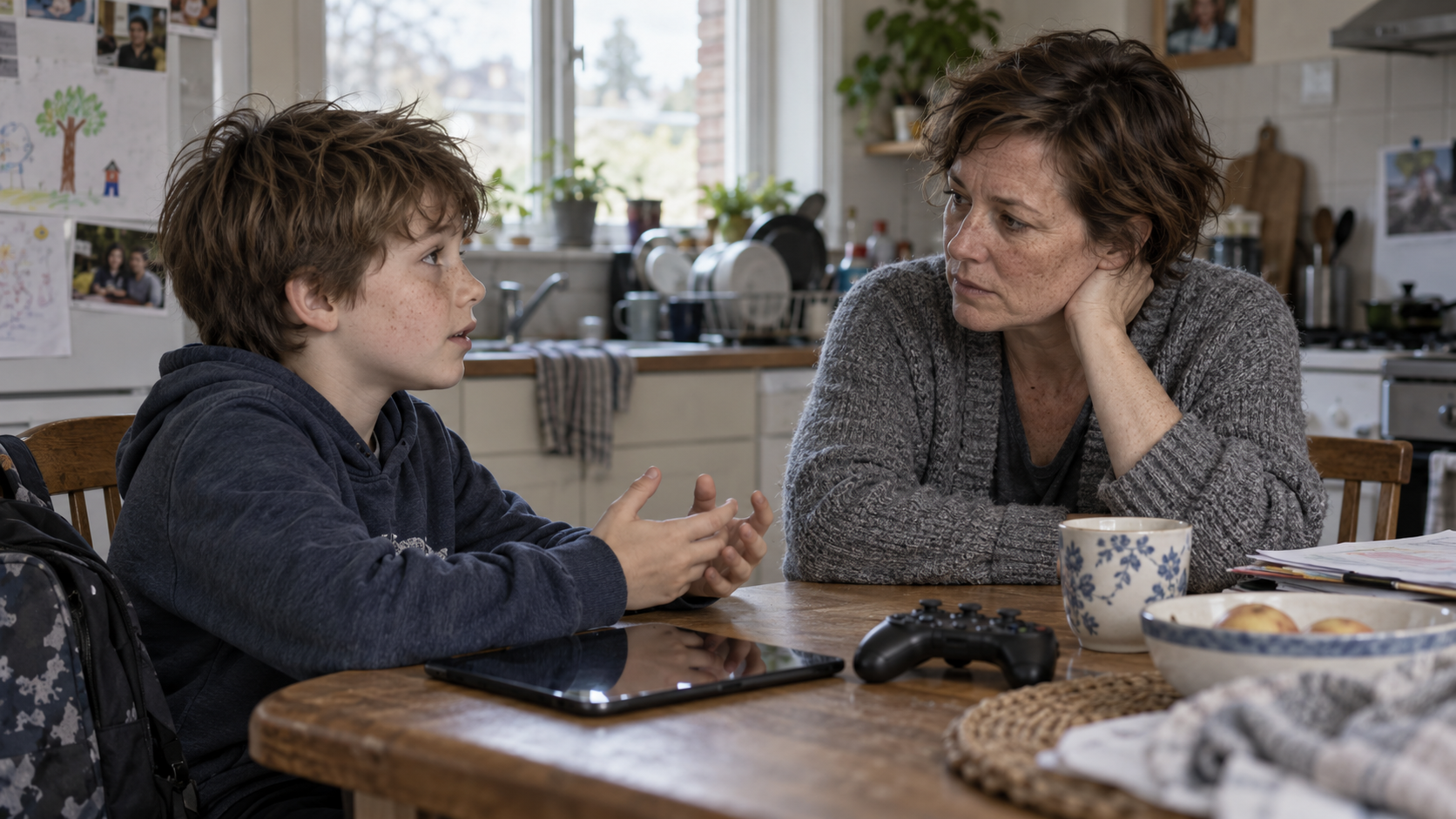
A parent can report what they have observed. A questionnaire cannot automatically supply the child’s perspective or a clinical diagnosis.
Describe the event before interpreting it
“We argued when the game ended on Tuesday” and “my child is addicted” make very different claims. The first describes something a parent may have witnessed. The second asks for an explanation that the episode alone cannot establish. A useful assessment should preserve that difference, even when an answer feels worrying or a report looks authoritative.
Consider an illustrative family disagreement: a parent asks for a game to stop immediately, while the child says a team round has not finished. There may be an unclear agreement, a difficult transition or a more persistent problem. The first task is to record what happened and what remains uncertain. The purpose is to understand the situation well enough to decide what to do next.
Even a time estimate has limits. Radesky and colleagues compared parents’ estimates with sampled smartphone and tablet use among children aged three to five. Many estimates were above or below the recorded amount. This concerns measuring use duration, not whether parents care or can describe a difficult event. A parent’s account and a device log answer different questions; neither alone supplies a diagnosis. Radesky et al., 2020
A clinical term has a specific meaning
The World Health Organization describes gaming disorder through impaired control, increasing priority given to gaming and continuation despite negative consequences. Significant impairment is required, and the pattern would normally be evident for at least 12 months. WHO also notes that the condition affects only a small proportion of people who game. An isolated disagreement or high enthusiasm does not supply those criteria. WHO: gaming disorder
Those criteria concern gaming disorder. They should not be casually transferred to every kind of screen use. HDI’s parent materials are not a clinical diagnostic service. A report can help organise observations and practical questions; it should not tell a parent that a child has a disorder because a selected answer sounds severe.
Make room for the child’s account
For school-age children, AAP guidance encourages parents to consider the child’s strengths and interests, keep room for schoolwork and other activities, and create a media plan with family conversation. That guidance supports a broader discussion than simply counting minutes. It does not establish the accuracy of HDI’s assessment or tell us what any individual child is thinking. AAP: school-age media guidance
Our suggested conversation prompt is simple: “What was happening for you then?” A younger child may need help describing the situation; an older child may disagree with the adult’s version. Record that disagreement as information. Do not turn an unanswered question into a negative finding, and do not ask a child to agree with a label in order to receive support.
What a useful report should let you check
Look for a visible connection between an answer, its interpretation and a proposed next step. If the report describes a difficult ending to a game, a suggestion should address that situation and respect any relevant constraints. A generic instruction to remove all devices skips the question of school access, communication and what the family can realistically organise.
Treat personalised suggestions as options to review, not commands backed by hidden certainty. Ask whether the example fits, whether the child recognises it and whether another caregiver sees a different pattern. These are editorial principles for using a report responsibly, not a claim that this approach has been clinically validated. If problems persist and seriously affect everyday functioning, seek advice from a qualified health professional; a self-guided programme should not stand in the way of that conversation.
Bring concrete examples to that discussion, including the circumstances around them. A clear account of an ordinary week is more useful than trying to make a child fit a dramatic headline.
Sources and scope
- World Health Organization — Addictive behaviours: Gaming disorder
Official explanation of ICD-11 gaming disorder. These criteria do not diagnose an individual or define all problematic screen use.
- American Academy of Pediatrics — Kids & Screen Time: 5 C’s Questions for School-Age Children
Professional guidance for ages 5–10. The cited recommendations are not an assessment-validation study and are not automatically extended to every age.
- Young Children’s Use of Smartphones and Tablets
Pediatrics, 146(1), e20193518. Ages 3–5; device sampling and parent estimates; not a diagnostic validation of HDI.
Sources supplied with this local draft; article claims and source admission remain subject to scientific review. These external works do not validate HDI’s questionnaire or establish the effectiveness of its programme. No external organisation’s endorsement is implied.