Understand
A reading of the routines you observe, suited to your child’s age.
Choose an age group to explore both sides.
FOR PARENTS · DIGITAL WELLBEING
A digital wellbeing assessment for parents of children aged 3–5. Complete a questionnaire about your family’s screen routines and receive a personalised report, age-appropriate improvement strategies, selected stories and a six-week plan for everyday family life.
Protect what growing up needs.
Screens can crowd out time for touch, movement, imagination, conversation and shared play. Young children need room to discover and invent things for themselves.
A digital wellbeing assessment for parents of children aged 6–11. Your questionnaire answers about screen routines at home shape a personalised report, practical improvement strategies, selected stories and a six-week plan for your family.
Protect what growing up needs.
Screens can take the place of making things, learning through trial and error, playing with friends and the satisfaction of doing something independently. Ready-made entertainment can fill the space where a child’s own idea might have emerged.
A digital wellbeing assessment for parents of teenagers aged 12–17. Complete a questionnaire about the routines you observe and your own screen habits. Receive a personalised report, improvement strategies, selected stories and a six-week plan built around conversation and shared boundaries.
Protect what growing up needs.
Screens can take over attention, time for sleep and friendships, and space to discover personal interests. Other people’s opinions and constant comparison can crowd out the questions: What do I want? What matters to me?
Parent edition preview · Enquiries open


THE BRIGHT SIDE
A reading of the routines you observe, suited to your child’s age.
Selected stories and a practical plan shaped around your answers.
Small changes you can bring into real family routines, and talk about together.
THE BRIGHT SIDE
Different ages. Different family routines. Five documents that work together.
Explore the personal report, six-week plan, selected stories and two practical sheets for your child’s stage.
Fictional example: Ines, parent of a 4-year-old. A tablet is easy to reach, while adults rarely choose what plays. Bedtime and shared reading are established routines.
All five documents use this fictional parent’s questionnaire answers. The helper and fridge examples include a practice selected from the same plan. These examples do not assess a real child or promise an outcome.
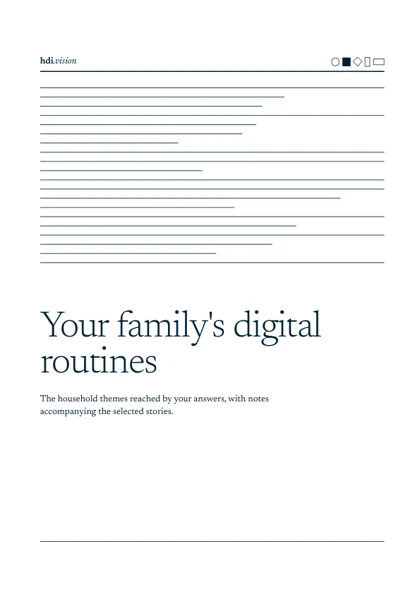
A reading of the household routines you describe, with relevant context and notes.
Open PDF ↗ (new tab)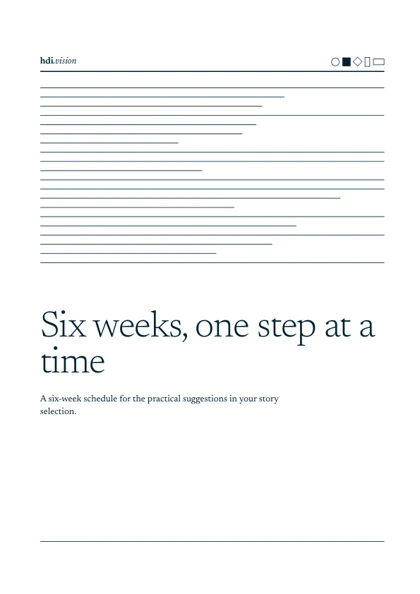
A practical schedule for the selected suggestions, with room to choose what fits.
Open PDF ↗ (new tab)
Up to three selected stories for parents, plus two read-aloud stories to share with your child.
Open PDF ↗ (new tab)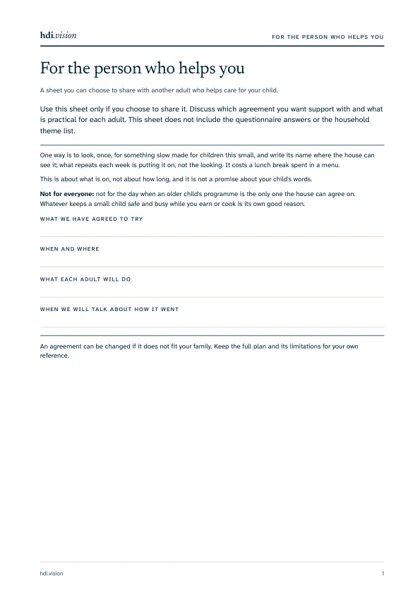
A chosen practice to discuss with another adult who helps care for your child.
Open PDF ↗ (new tab)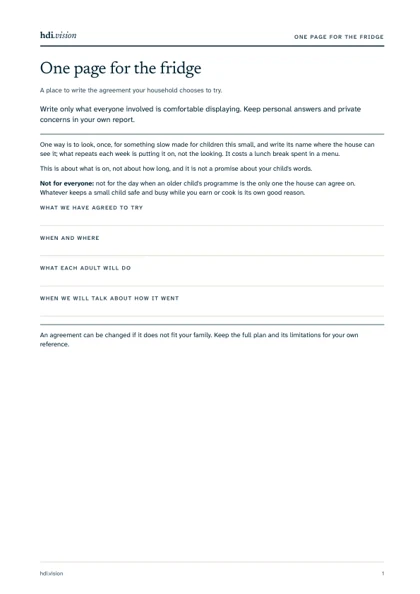
One practice from the plan, with space to agree when and how to try it.
Open PDF ↗ (new tab)Fictional example: Marko, parent of a 9-year-old. Devices are easy to access. Conversations about games and advertising are infrequent.
All five documents use this fictional parent’s questionnaire answers. The helper and fridge examples include a practice selected from the same plan. These examples do not assess a real child or promise an outcome.
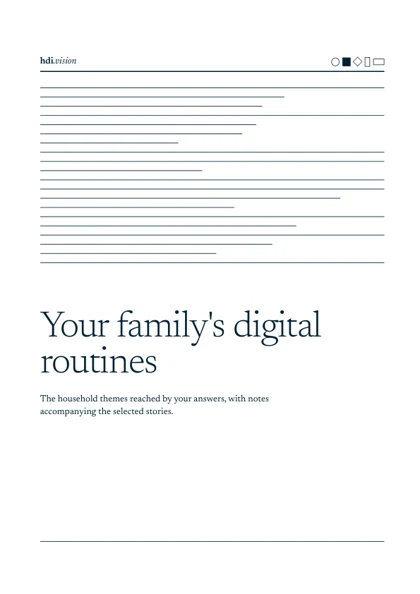
A reading of the household routines you describe, with relevant context and notes.
Open PDF ↗ (new tab)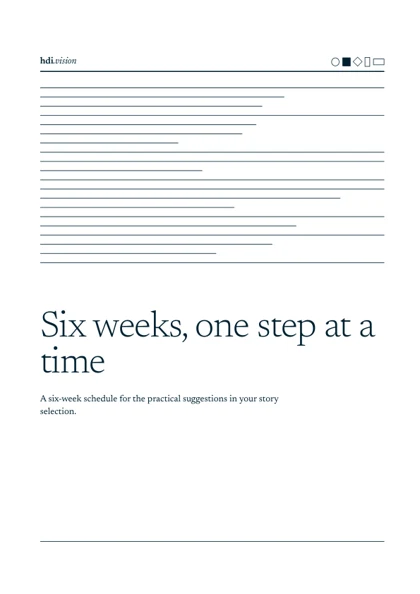
A practical schedule for the selected suggestions, with room to choose what fits.
Open PDF ↗ (new tab)
Up to three selected stories for parents, with notes and sources.
Open PDF ↗ (new tab)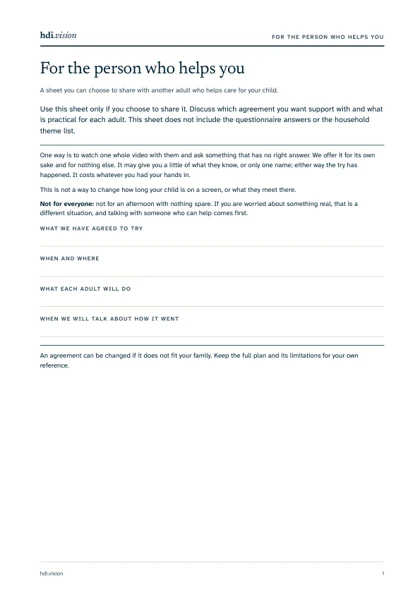
A chosen practice to discuss with another adult who helps care for your child.
Open PDF ↗ (new tab)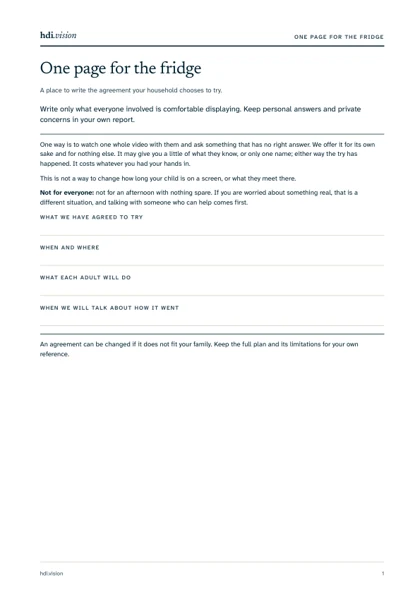
One practice from the plan, with space to agree when and how to try it.
Open PDF ↗ (new tab)Fictional example: Damir, parent of a 15-year-old. A phone is often used during shared meals. Overnight charging is already outside the bedroom.
All five documents use this fictional parent’s questionnaire answers. The helper and fridge examples include a practice selected from the same plan. These examples do not assess a real child or promise an outcome.
A reading of the household routines you describe, with relevant context and notes.
Open PDF ↗ (new tab)
A practical schedule for the selected suggestions, with room to choose what fits.
Open PDF ↗ (new tab)
Up to three selected stories for parents, with notes and sources.
Open PDF ↗ (new tab)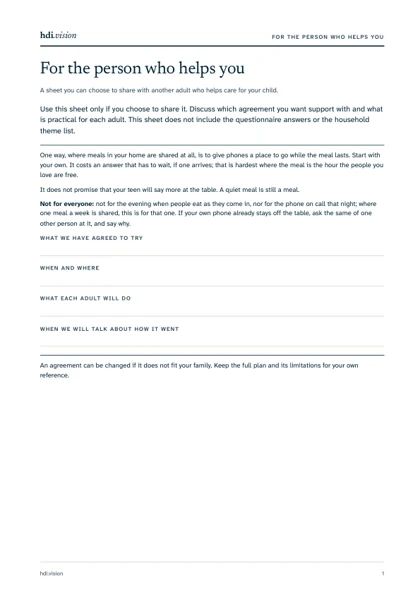
A chosen practice to discuss with another adult who helps care for your child.
Open PDF ↗ (new tab)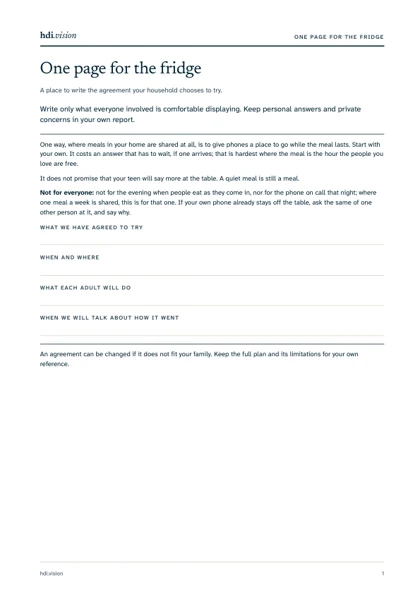
One practice from the plan, with space to agree when and how to try it.
Open PDF ↗ (new tab)YOUR PROGRAMME
Preview: payment is not enabled. You can review a package now. No order is placed.
ONE CHILD
€89One-time payment
FAMILY · UP TO THREE CHILDREN
€149One-time payment
Prices are shown so you can plan. Ordering opens when the test opens.
One-time purchase model. Download rights, online access duration, repeat assessments, support and age-transition terms are being finalised before sales open.
Not yet. This is a package and order preview. Card payment will be connected after testing; no payment or order is created here.
Download rights, online access duration, repeat assessments, age transitions and support are still being finalised. The final terms will be shown before payment becomes available.
No. The programme provides educational guidance and practical reflection. It does not replace professional care.
THE BRIGHT SIDE
Shared viewing, background screens, bedtime and your own phone habits.
Choose one familiar routine, such as putting screens aside for a shared story. Keep the change small enough to repeat.
Device access, shared time, content, household agreements and the example adults set.
Choose one household agreement together, explain its purpose and return to it after trying it in everyday life.
Overnight devices, shared meals, open conversations, agreed boundaries and your own screen use.
Agree on one boundary together, including what the adults will do. Revisit it as independence and circumstances change.
THE BRIGHT SIDE
Choose the right age group and describe what you can actually observe. Include your own screen habits.
Explore the report and creative material. Recognise a familiar pattern; question what does not fit.
Choose a manageable practice, try it in daily life and return to what you notice. Change need not happen all at once.
THE BRIGHT SIDE
A review covering 176,742 children under six found associations between screen-use contexts and developmental outcomes. These associations do not establish that a screen habit caused an outcome in an individual child.
Mallawaarachchi et al., 2024 · Read the study ↗Current American Academy of Pediatrics guidance considers children’s digital environments, including family routines and adult involvement. Guidance helps frame a conversation; it is not evidence that a particular HDI report improves outcomes.
AAP, 2026 · Read the guidance ↗In a randomised trial involving 89 families and 181 children and adolescents, a strict two-week reduction in leisure screen use improved parent-reported difficulties. The short follow-up limits what it tells us about lasting effects; this was not a trial of HDI.
Schmidt-Persson et al., 2024 · Read the study ↗Current American Academy of Pediatrics guidance considers children’s digital environments, including family routines and adult involvement. Guidance helps frame a conversation; it is not evidence that a particular HDI report improves outcomes.
AAP, 2026 · Read the guidance ↗A meta-analysis of 125,198 children and young people aged 6–19 linked bedtime portable-device use or access with poorer sleep outcomes. The included studies were cross-sectional, so the findings cannot establish cause and effect.
Carter et al., 2016 · Read the study ↗Current American Academy of Pediatrics guidance considers children’s digital environments, including family routines and adult involvement. Guidance helps frame a conversation; it is not evidence that a particular HDI report improves outcomes.
AAP, 2026 · Read the guidance ↗THE BRIGHT SIDE
The parent or caregiver answers about observable routines and their own behaviour. This is not a questionnaire completed by the child.
Choose preschool (3–5), school age (6–11) or teenagers (12–17). The current parent edition does not cover under-threes or adults. Children in different age groups? Each age group has its own questionnaire, and each child receives their own set of documents.
No. The report is a reflection of a caregiver’s answers. It does not diagnose a child, infer a teenager’s private thoughts or replace professional support.
Explore the demonstration documents, then choose a package and review its price. Payment is not enabled yet; no order is placed in this preview.
THE BRIGHT SIDE
Tell us what you would like to explore for your family.
Start the conversation →Opens your email app. Please leave out sensitive personal details.
FOR PARENTS · THE DARK SIDE
A digital wellbeing assessment for parents of children aged 3–5. Complete a questionnaire about your family’s screen routines and receive a personalised report, age-appropriate improvement strategies, selected stories and a six-week plan for everyday family life.
Protect what growing up needs.
Screens can crowd out time for touch, movement, imagination, conversation and shared play. Young children need room to discover and invent things for themselves.
A television left on. A phone at story time. Another episode before bed. At this age, the whole screen environment matters.
A digital wellbeing assessment for parents of children aged 6–11. Your questionnaire answers about screen routines at home shape a personalised report, practical improvement strategies, selected stories and a six-week plan for your family.
Protect what growing up needs.
Screens can take the place of making things, learning through trial and error, playing with friends and the satisfaction of doing something independently. Ready-made entertainment can fill the space where a child’s own idea might have emerged.
Entertainment, schoolwork and social life can arrive through the same screen. Notice when the transitions stop working for your family.
A digital wellbeing assessment for parents of teenagers aged 12–17. Complete a questionnaire about the routines you observe and your own screen habits. Receive a personalised report, improvement strategies, selected stories and a six-week plan built around conversation and shared boundaries.
Protect what growing up needs.
Screens can take over attention, time for sleep and friendships, and space to discover personal interests. Other people’s opinions and constant comparison can crowd out the questions: What do I want? What matters to me?
You can notice an overnight phone or an interrupted meal. You cannot read a teenager’s inner life from a screen. Start with a conversation.
THE DARK SIDE
A conversation, a game or a task loses its place.
Rest gets pushed behind the next episode, message or update.
Something repeated becomes the default before anyone agrees to it.
THE DARK SIDE
You answer as the caregiver. The report reflects the home routines you describe; it does not measure or diagnose your child.
Use the report to open a conversation about routines. Leave room for uncertainty and for your child’s perspective.
Your observations offer one perspective. They cannot establish what your child thinks or feels when you are not there.
Use the report to open a conversation about routines. Leave room for uncertainty and for your child’s perspective.
This is a parent perspective, not a hidden assessment of your teenager. We do not infer their motives, private feelings or symptoms from your answers.
Use the report to open a conversation about routines. Leave room for uncertainty and for your child’s perspective.
THE DARK SIDE
Four horsemen. Three stages of growing up.
These are editorial themes for noticing family routines, not diagnoses or four measured child traits. The examples below change with your selected age group.
Notice which screens are on during play and shared routines, including background television.
Think about the content you choose, what follows it and whether you watch together.
Describe what happens around bedtime, including when screens are put away.
Include your own phone use during meals, play and time together.
Look at the place screens take alongside homework, active play and shared activities.
Consider content choices and access to devices, including what your child encounters when using them alone.
Describe device access in the bedroom and the routines that lead into bedtime.
Look at family meals, shared activities, adult phone use and the rules you actually follow together.
Start with interruptions you actually observe, such as devices during shared meals. Avoid guessing how the whole day was spent.
Ask about experiences with curiosity. Leave room for what your teenager chooses to share and for what you do not know.
Discuss overnight device arrangements openly. A parent’s observation is not a sleep diagnosis.
Reflect on your own availability, shared agreements and open conversations. Support does not require covert monitoring.
THE DARK SIDE
Shared viewing, background screens, bedtime and your own phone habits.
Choose one familiar routine, such as putting screens aside for a shared story. Keep the change small enough to repeat.
Device access, shared time, content, household agreements and the example adults set.
Choose one household agreement together, explain its purpose and return to it after trying it in everyday life.
Overnight devices, shared meals, open conversations, agreed boundaries and your own screen use.
Agree on one boundary together, including what the adults will do. Revisit it as independence and circumstances change.
THE DARK SIDE
A review covering 176,742 children under six found associations between screen-use contexts and developmental outcomes. These associations do not establish that a screen habit caused an outcome in an individual child.
Mallawaarachchi et al., 2024 · Read the study ↗Current American Academy of Pediatrics guidance considers children’s digital environments, including family routines and adult involvement. Guidance helps frame a conversation; it is not evidence that a particular HDI report improves outcomes.
AAP, 2026 · Read the guidance ↗In a randomised trial involving 89 families and 181 children and adolescents, a strict two-week reduction in leisure screen use improved parent-reported difficulties. The short follow-up limits what it tells us about lasting effects; this was not a trial of HDI.
Schmidt-Persson et al., 2024 · Read the study ↗Current American Academy of Pediatrics guidance considers children’s digital environments, including family routines and adult involvement. Guidance helps frame a conversation; it is not evidence that a particular HDI report improves outcomes.
AAP, 2026 · Read the guidance ↗A meta-analysis of 125,198 children and young people aged 6–19 linked bedtime portable-device use or access with poorer sleep outcomes. The included studies were cross-sectional, so the findings cannot establish cause and effect.
Carter et al., 2016 · Read the study ↗Current American Academy of Pediatrics guidance considers children’s digital environments, including family routines and adult involvement. Guidance helps frame a conversation; it is not evidence that a particular HDI report improves outcomes.
AAP, 2026 · Read the guidance ↗THE DARK SIDE
You answer as the caregiver. The report reflects the home routines you describe; it does not measure or diagnose your child.
If you are worried about your child’s wellbeing or safety, seek appropriate professional support. A report is not a substitute for that conversation.
Your observations offer one perspective. They cannot establish what your child thinks or feels when you are not there.
If you are worried about your child’s wellbeing or safety, seek appropriate professional support. A report is not a substitute for that conversation.
This is a parent perspective, not a hidden assessment of your teenager. We do not infer their motives, private feelings or symptoms from your answers.
If you are worried about your child’s wellbeing or safety, seek appropriate professional support. A report is not a substitute for that conversation.
THE DARK SIDE
Take the next step with curiosity, not guilt.